The quickest way to get invoices paid faster is to remove every reason for a client to wait. Send the invoice the same day as the job, make sure it is a valid tax invoice, put clear payment details on it (PayID is the fastest option), state the due date, and follow up on a set schedule. Invoice finance can turn unpaid invoices into cash, but it is a cost, not a fix. Most late payment is a process problem you can solve yourself.
This guide is for tradies, freelancers, consultants and small business owners who bill clients directly. It covers what to do before, during and after you send an invoice.
TL;DR
- Send the invoice the same day, ideally from your phone before you leave the job.
- Put payment details, including PayID, directly on the invoice so paying takes seconds.
- Agree payment terms in writing before work starts, even for small jobs.
- Follow up on a fixed schedule, starting a few days after the due date, and stay friendly.
- Use invoice finance only when you have a genuine cash gap with large, reliable debtors, and understand it costs money.
Table of Contents
- Why invoices get paid late
- Send the invoice the same day
- Make it a valid tax invoice
- Put payment details on the invoice, and use PayID
- Set payment terms before the job starts
- Perspective: why we built Ozinvoice for speed
- Follow up on a schedule
- Make paying a one-step action
- Where Ozinvoice fits
- When invoice finance makes sense
- A worked example
- A checklist to put in place this week
- FAQ
- Sources
Why invoices get paid late
Most late payments are not malicious. The client was busy, the invoice landed in a crowded inbox, or they could not work out how to pay you. Some simply did not know when payment was expected.
The numbers show it is common. Ezidebit's 2025 Payment Pulse research found that 54% of businesses report regular late or missing payments. Atradius's 2025 payment practices research puts the average Days Sales Outstanding for Australian businesses at 42 days. That means the typical business waits about six weeks to collect.
The pressure is also coming from the top. The Payment Times Reporting Regulator notes that large businesses are being encouraged to pay small suppliers within 30 days. If you are a small supplier, setting your own terms around that 30-day norm puts you in step with where the market is heading.
The delay usually comes from one of four places:
- You invoice late. The clock does not start until the client has the invoice.
- The invoice is unclear or invalid. Missing details give an accounts team a reason to bounce it.
- Paying is awkward. Typing a BSB and account number off a PDF is a chore people put off.
- Nobody follows up. Without a nudge, the invoice sinks down the pile.
The rest of this article fixes each one.
Send the invoice the same day
The single biggest lever is speed. An invoice sent on the day of the job is paid while the work is fresh and the client is still happy. An invoice sent three weeks later arrives when the job is forgotten and the cash has gone elsewhere.
The reason people delay is rarely laziness. It is the admin: getting home, opening a laptop, finding the last invoice to copy, retyping a client's details, working out GST. If it takes 20 minutes, it gets pushed to the weekend.
Practical fixes:
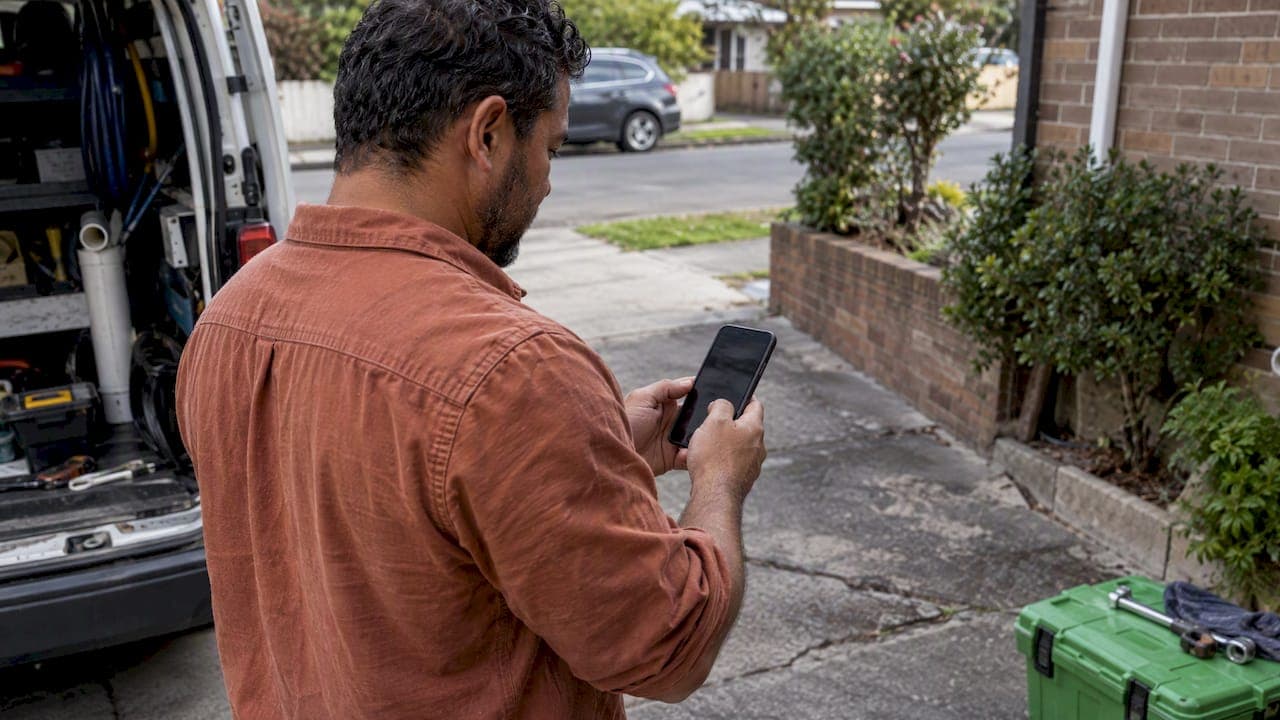
- Invoice from your phone, on site. If you can finish the invoice in the ute or at the café table, it goes out before you start the next job.
- Use a template. Save your business details, ABN, logo and common line items so each invoice is only a few changes.
- Set a fixed invoicing moment. For ongoing work, pick a day and time, such as every Friday at 3 pm, and treat it like a booking.
- Invoice on completion, not at the end of the month. Month-end batching adds up to 30 days of delay for nothing.
Make it a valid tax invoice
If you are registered for GST, a sloppy invoice is a gift to a slow payer. Accounts teams reject invoices that are missing details, and the clock restarts.
According to the ATO's tax invoice rules, a tax invoice for a sale over $82.50 (GST inclusive) must show:
- the words "tax invoice"
- your identity and ABN
- the date of issue
- a description of the goods or services
- the GST amount
- the extent of the taxable sales
For sales of $1,000 or more, the buyer's identity or ABN is also required. The ATO also says that if a customer asks for a tax invoice, you must provide one within 28 days, unless the sale is $82.50 (including GST) or less.
The business.gov.au invoicing guide adds the practical side: an invoice should tell the customer how much they owe, when to pay and how they can pay you. Those last two are where most invoices fall down.
Put payment details on the invoice, and use PayID
Think about the client's side. They open your invoice, agree it is fair, and want to be done with it. If the next step is hunting for their banking app, typing eight digits of account number and six of BSB, and hoping they got it right, many will say "I'll do it later".
PayID removes that friction. According to PayID, payments are near-instant, often under a minute, and the system shows a payee confirmation step, which reduces mistaken payments and fraud compared with entering BSB and account numbers. Sole traders can register a mobile number as a PayID, and companies can register an ABN, as Westpac's business PayID page explains. Other banks offer the same, so check your own banking app.
Two habits make PayID work:
- Put it on every invoice, in the same place, next to the total and due date.
- Include the invoice number as the payment reference so you can match the money to the job.
One caution: only share a PayID you have registered yourself, and when you receive a payment, check it in your own banking app rather than trusting a screenshot a client sends you.
Set payment terms before the job starts
An invoice is a request. Payment terms are the agreement that makes the request reasonable. Business.gov.au describes payment terms as the rules for how and when customers must pay, forming part of a sales contract under contract law. It recommends adding them to both invoices and contracts so customers know what is expected.
In practice, that means writing down, even for a simple job:
- when payment is due (on completion, 7 days, 14 days, 30 days)
- how you accept payment
- whether you take a deposit or progress payments
- what happens if payment is late
This is the "payment culture" idea: set expectations at the start so that nobody can later say it was an oversight. A short line in the quote is enough: "Payment due on completion by PayID or card."
Choose shorter terms than you think
Many sole traders default to 30 days because it feels normal. If your clients are households or small businesses, you can usually ask for payment on completion or within 7 days. Reserve 14 to 30 day terms for larger businesses that have set procedures. The shorter the term, the shorter the wait, and the earlier you will know if there is a problem.
Deposits and progress payments
For larger jobs, a deposit before starting and staged payments reduce your exposure. A tradie quoting a bathroom renovation should not be funding materials and labour for six weeks and waiting for the full amount at the end.
Late payment fees and interest
You can charge interest on overdue invoices only if the customer agreed to it first. Lawpath explains that without a late payment clause in your contract or terms, you generally have no right to add interest afterwards. Put it in your quote or terms before work begins. Even if you never charge it, its presence signals that you take due dates seriously.
Perspective: why we built Ozinvoice for speed
We look at late payment from the side of the person doing the work. A plumber finishes a job at 4 pm, has two more call-outs, and the invoice drops to the bottom of the list. That is not carelessness. It is that most invoicing software was built for bookkeepers, not for someone standing in a driveway.
So we took a narrow view. An invoice should take about 60 seconds, work from a phone, and carry everything the client needs to pay without a phone call: GST worked out, your ABN, and PayID details on the page. We think that combination, not a long feature list, does most of the work in getting paid faster.

We also think the follow-up should be cheap and automatic, because the awkward part of chasing is rarely the maths. It is the feeling of nagging a client. A neutral reminder that arrives on schedule feels like process, not pressure.
And we do not think a sole trader should pay a monthly fee that costs more than the invoices they send. That is why the first two invoices every month are free.
— Dane
Follow up on a schedule
A missed payment can well be an oversight. Business.gov.au suggests getting in touch by phone, email, letter or in person with a friendly reminder, discussing a new payment date, or negotiating a payment schedule if needed.
A simple cadence you can adapt:
| When | Action | Tone |
|---|---|---|
| Day of issue | Send invoice by SMS or email with payment details | Thank-you |
| 2 days before due date | Optional short reminder for larger clients | Helpful |
| 3 to 7 days after due date | Friendly reminder with the invoice attached again | Assuming oversight |
| 14 days after due date | Phone call; offer a payment plan if needed | Direct but polite |
| 30 days after due date | Written notice referring to your terms; consider the options below | Formal |
Some points on making this work:
- Call, do not just email, once an invoice is a week or two overdue. A voice gets a promise and a date.
- Always re-send the invoice with the reminder, so the client does not need to look for it.
- Pause further work for a client who has an overdue balance, if your terms allow it.
- Keep a record of every contact. If it ever escalates, dates and messages matter.
If you reach the point where a client will not pay at all, the business.gov.au page above sets out the next steps. For significant amounts, talk to a lawyer or your accountant before you take formal action.
Make paying a one-step action
Beyond PayID, a few small touches shorten the time between opening and paying:
- Send by SMS as well as email. Texts are read quickly, and a tradie's customer is more likely to act on a text than an email that lands among newsletters.
- Use a clear subject or message. "Invoice #1042 from Smith Electrical, $385.00, due 5 November" tells the client everything before they open it.
- Itemise lines. A short breakdown of labour and materials stops the "what is this for?" reply that costs a week.
- Add your branding. An invoice that looks professional and matches your quote is less likely to be questioned or mistaken for spam.
- Send a receipt. Confirming payment closes the loop and builds trust for the next job.
The business.gov.au invoicing guide makes the same point from a different angle: the most overlooked feature is not the invoice itself, but whether the payment details are on it.
Where Ozinvoice fits
If your main problem is that invoicing is slow and awkward, Ozinvoice is built for that. You create a GST-ready tax invoice on your phone or desktop, send it by SMS or email, and include PayID payment details on every invoice. GST is calculated automatically, you can add line items and your own branding, save templates, send payment reminders and create receipts.
You can send two invoices a month free. For unlimited invoicing, the pricing page lists the plans: Free Forever at $0 per month, Monthly at $4 per month, or Annual at $35 per year. It is aimed at tradies, freelancers, consultants and small business owners who want a simple tool, not a full accounting package. If you need complex accounting integrations, it is not the right fit.
When invoice finance makes sense
Search results for this topic are dominated by invoice finance, so it deserves an honest look. Invoice finance, also called debtor finance or invoice factoring, lets a business draw cash against invoices that customers have not yet paid.
According to OptiPay's FAQ, providers typically advance around 80 to 85% of an invoice's value, without needing property as security. CommBank describes its Stream Working Capital product as an invoice financing facility giving eligible businesses access to up to 80% of unpaid invoice value, with the balance adjusting automatically as customers pay. Earlypay's explainer also outlines how debtor finance works.
It can be useful when:
- you invoice larger businesses on 30, 60 or 90-day terms and cannot shorten them
- you have to pay wages, suppliers or materials well before the money arrives
- your invoices are sizeable and your debtors are reliable
It is a poor fit when:
- your invoices are small and your clients are households, where better invoicing and payment on completion solve the problem for free
- the real issue is a client who does not pay, since finance providers generally want creditworthy debtors
- you have not yet fixed your own process, because you would be paying fees to cover a delay you could avoid
Fees and conditions vary by provider, so read the terms and ask an accountant or financial adviser to compare the full cost with your alternatives before signing.
A worked example
Take a sole trader electrician who completes 20 jobs a month, averaging $400 each, so $8,000 billed monthly.
Before: invoices are written up on a laptop on Sunday night, emailed as PDFs with BSB and account number, and carry 14-day terms. Jobs are billed an average of 6 days after completion, and clients pay about 12 days after that. That is roughly 18 days from job to cash, and a few invoices drift to a month or more.
After: the invoice is sent from the phone before leaving the site, by SMS, with PayID on it and "due on completion" in the quote. Many clients pay within minutes or that evening. Anyone still unpaid at 3 days gets a reminder.
The figures are illustrative, not a promise, but the logic is the point. Each step you remove, whether the delay in sending, the effort of paying or the lack of a follow-up, brings the cash in sooner.
A checklist to put in place this week
- Decide your standard payment terms and write them into your quote template.
- Register a PayID with your bank if you have not already, and confirm it works.
- Save your ABN, logo and common line items in an invoice template.
- Commit to sending each invoice on the day of the job.
- Add a due date, payment instructions and invoice number to every invoice.
- Put reminders in your calendar for 3 to 7 days after each due date, or automate them.
- For jobs over a few thousand dollars, take a deposit.
FAQ
How long should an invoice take to get paid?
There is no single legal figure. It depends on the terms you set, and you should state them on the quote and invoice. Atradius's 2025 research puts average DSO for Australian businesses at 42 days, but for household customers and small jobs, payment on completion or within 7 days is a reasonable ask.
What must be on an invoice in Australia?
For GST-registered businesses selling over $82.50 (GST inclusive), a tax invoice needs the words "tax invoice", your identity and ABN, the issue date, a description of what you supplied, the GST amount and the extent of taxable sales. At $1,000 or more, the buyer's identity or ABN is also required. The ATO's tax invoice page has the current rules.
What is debtor factoring?
It is a way of getting cash from invoices that are not yet paid. A provider advances a large share of the invoice value, commonly 80 to 85%, and you repay it as your customers pay. It carries fees, so it suits businesses with a real timing gap, not those who just need to invoice sooner.
What is the best free invoice app in Australia?
The best one is the one you will actually use on the job, so look for GST-ready tax invoices, mobile use, SMS or email delivery and PayID details on the invoice. Ozinvoice lets you send two invoices a month free, and the Free Forever plan costs $0 per month. Try it against your own workflow before committing to anything paid.
Sources
- Tax invoices, Australian Taxation Office
- How to invoice, business.gov.au
- Payment terms, business.gov.au
- What to do when you haven't been paid, business.gov.au
- Payment Times Reporting Regulator update, July 2025
- Payment Practices Barometer Australia 2025, Atradius
- 2025 Payment Pulse, Ezidebit
- PayID
- PayID for business, Westpac
- Can I charge customers interest on unpaid invoices?, Lawpath
- Frequently asked questions, OptiPay
- Stream Working Capital, CommBank
- What is debtor finance and how does it work?, Earlypay